


Opatija Chocolate Festival 2026: 7 Delicious Reasons to Go
- 27/10/2026
- Chocolate, Exploring Kvarner, Gastronomy
November in Opatija usually means a quieter Lungomare, the first autumn rain and coffee on a terrace with a blanket over your…
Read More by Chiara
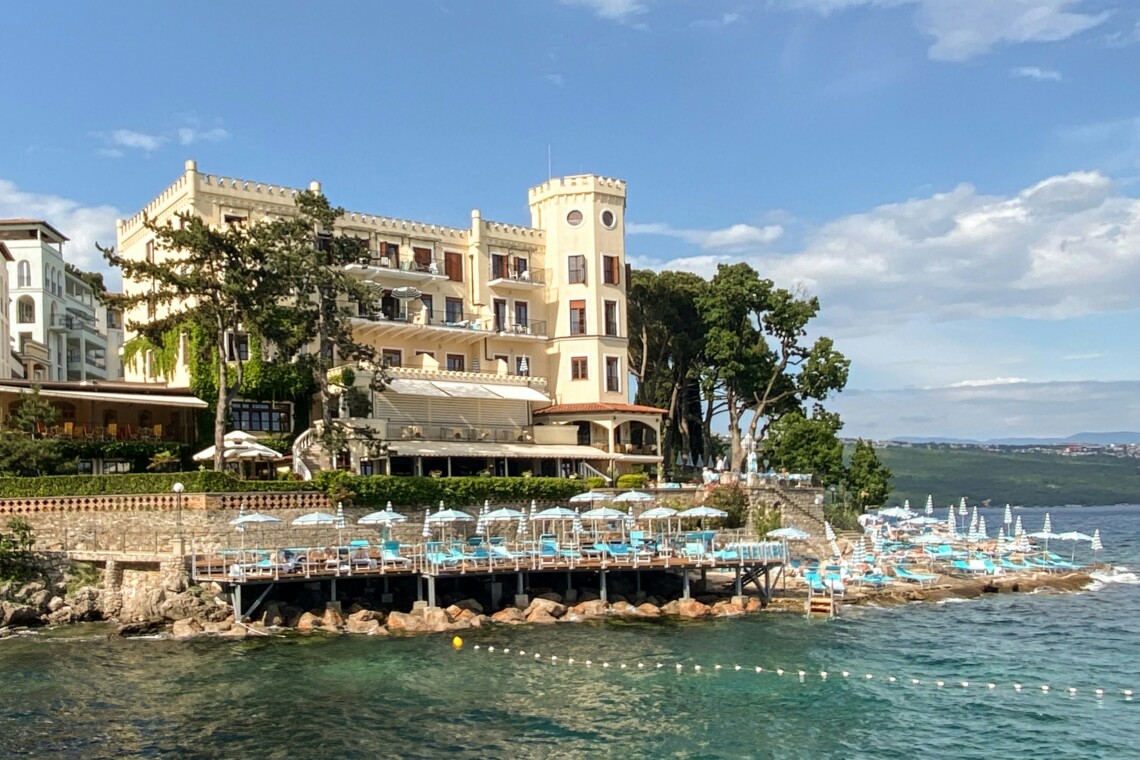
Most towns on the Adriatic grew up around a harbour or an old town square. Opatija grew up around villas. Two centuries ago there were only a few fishermen’s houses and the little church of St James here. Today almost every street in the centre is lined with façades, balconies, columns and gardens full of palms.
The historic villas in Opatija are best discovered on foot, slowly and with a story in mind. That is why we have put together a walk through seven villas that tell the town’s story best, from the very first villa to one you can actually stay in.
It all starts in 1844, when Iginio Scarpa, a merchant from Rijeka, builds a summer villa by the sea and plants a park around it. The villa quickly becomes a meeting place for high society. The turning point is a visit by Empress Maria Anna, who spent almost three months there, and after that all of Vienna starts paying attention to Opatija.
The real breakthrough comes with the Southern Railway Company. It buys the villa and its grounds in 1882, opens Hotel Kvarner two years later and Hotel Imperial soon after. In 1889 Opatija is officially declared a climatic health resort. In just thirty years, up to the First World War, the village turns into one of Europe’s most elegant resorts, above all a winter one: aristocrats come here to escape the cold winters of Central Europe.
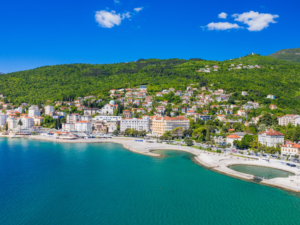
Most villas were designed by architects of the Viennese school, and one of them gave Opatija its face. Carl Seidl, a Moravian trained in Vienna, first came here in 1885 and went on to design around thirty buildings in Opatija, most of them villas. He is the reason the town still looks like a garden full of country houses.
On your walk, look out for three things. First, the façades in the spirit of historicism, with motifs borrowed from the Renaissance, antiquity and the Gothic. Second, the Art Nouveau details on balconies, railings and windows. Third, the gardens, because a villa in Opatija almost never stands alone, it is always surrounded by a park.
Start your walk in Angiolina Park, at the villa the park is named after. Villa Angiolina is a graceful neoclassical building with columns and a richly painted interior, and today it houses the Croatian Museum of Tourism. Next to it stands the Swiss House from 1875, once an outbuilding of the villa.
Take your time in the park too. It is home to sequoias, ginkgo trees, holm oaks and camellias, the flower that became Opatija’s symbol.
Across from the park, at Sv. Florijana 1, stands a large villa from 1897. Few buildings in Opatija have changed roles so often: it started as a German reading room with a café, spent a few years as a hotel and restaurant, became the seat of a shooting club in 1913, and more recently, under the name Operetta, a shopping centre.
The villa is a protected cultural monument, but it is empty today and closed to visitors. Take a look from outside, as a reminder of how many of these buildings have outlived their owners.
Head down towards the sea, to the first hotel on the eastern Adriatic coast. Hotel Kvarner opened in 1884, and six years later Villa Amalia rose next to it, built in the same style for guests who wanted more peace and privacy. The villa was a favourite of the German imperial family.
Its most famous guest, though, was the dancer Isadora Duncan. She stayed here in 1902 and later wrote in her memoirs that the palms outside her window inspired the arm movements she became famous for. Her statue, by Opatija sculptor Tatjana Kostanjević, now stands in front of the villa. Read more on the Villa Amalia website.
On the Lungomare, near the Maiden with the Seagull statue, stands Hotel Milenij. Its oldest part is a villa that Carl Seidl extended and reshaped in 1908. The walls of its hall were painted by the Viennese painter Karl Ludwig Hassmann with scenes from Greek mythology.
This is also the best place for a break on your walk. On the ground floor you will find Café Wagner, a Viennese café with a terrace above the sea, so you can enjoy a slice of cake with a view of the villa.
Not far from Opatija’s small harbour stands a villa many consider one of Seidl’s finest. Villa Frappart, named after its owner Dr Frappart, was built between 1894 and 1905. You will recognise it by its portico, terraces and decorations in the Venetian floral Gothic style that Seidl was particularly fond of.
For the last stretch, follow the Lungomare for about fifteen minutes from the centre. Villa Ariston was built in 1908 for Baroness Hedwig von Haas-Teichen, and it got its look of a Mediterranean villa rising from the rocks above the sea when Carl Seidl rebuilt it between 1915 and 1924.
The interior has been almost entirely preserved, with old paintings on the walls, and in front of the villa grows a palm that some say is the oldest in Opatija. Today it is a small hotel with a restaurant on a terrace by the sea. Read more about its past on the Villa Ariston website.
We end the walk where you could actually start it. Villa Sokol stands at Sv. Florijana 2, right across from Angiolina Park and next door to Villa Gorovo. It is a Belle Époque villa with high, ornamented ceilings and a balcony overlooking the park.
On the first floor you will find our Villa Sokol apartment, 85 m² with two bedrooms for up to four guests. The interior has been renovated, but the spirit of old Opatija remains. If you want to experience the historic villas in Opatija from the inside, not just from the pavement, you will hardly find a better place.
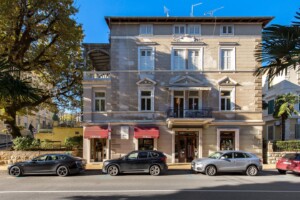
A walk through Opatija and its villas works in any season, and in winter it may be at its best, because that is when you really feel why European aristocrats spent the cold months here. To learn more about the town’s art and culture, read our guide to Opatija’s cultural scene.
November in Opatija usually means a quieter Lungomare, the first autumn rain and coffee on a terrace with a blanket over your…
Read More
Opatija has a quieter kind of charm in the rain. The Lungomare empties, the sea turns grey-green and the old villas in…
Read More
Opatija market and Rijeka’s Placa are the best places to get to know Kvarner as it really is….
Read More


Join The Discussion